The European Commission’s proposals to simplify ESG regulations as part of the so-called Omnibus Package published on February 26th 2025 have sparked...
Sylwia Mindykowska
Sustainability Consultant
Join our newsletter
We do not spam! No more than once a month you will receive an email with interesting information from the world of finance!
Because of numerous queries received concerning what a German invoice should look like and what it should include, we decided to draw up a set of guidelines on how to issue such documents correctly.
Accounting in Germany
When issuing German invoices, you must remember that there are two types of VAT numbers in Germany:
Steuernummer (St.-Nr.), intended for domestic transactions – requires a German tax rate
Umsatzsteuer-Identifikationsnummer (USt.-IdNr.), intended for German taxpayers conducting intra-Community transactions
The former number must be included on the invoice as soon as it is assigned. The moment the latter number is assigned, both of them must appear on the invoice. This refers to the sales of goods/services to the private German consumers (not companies).
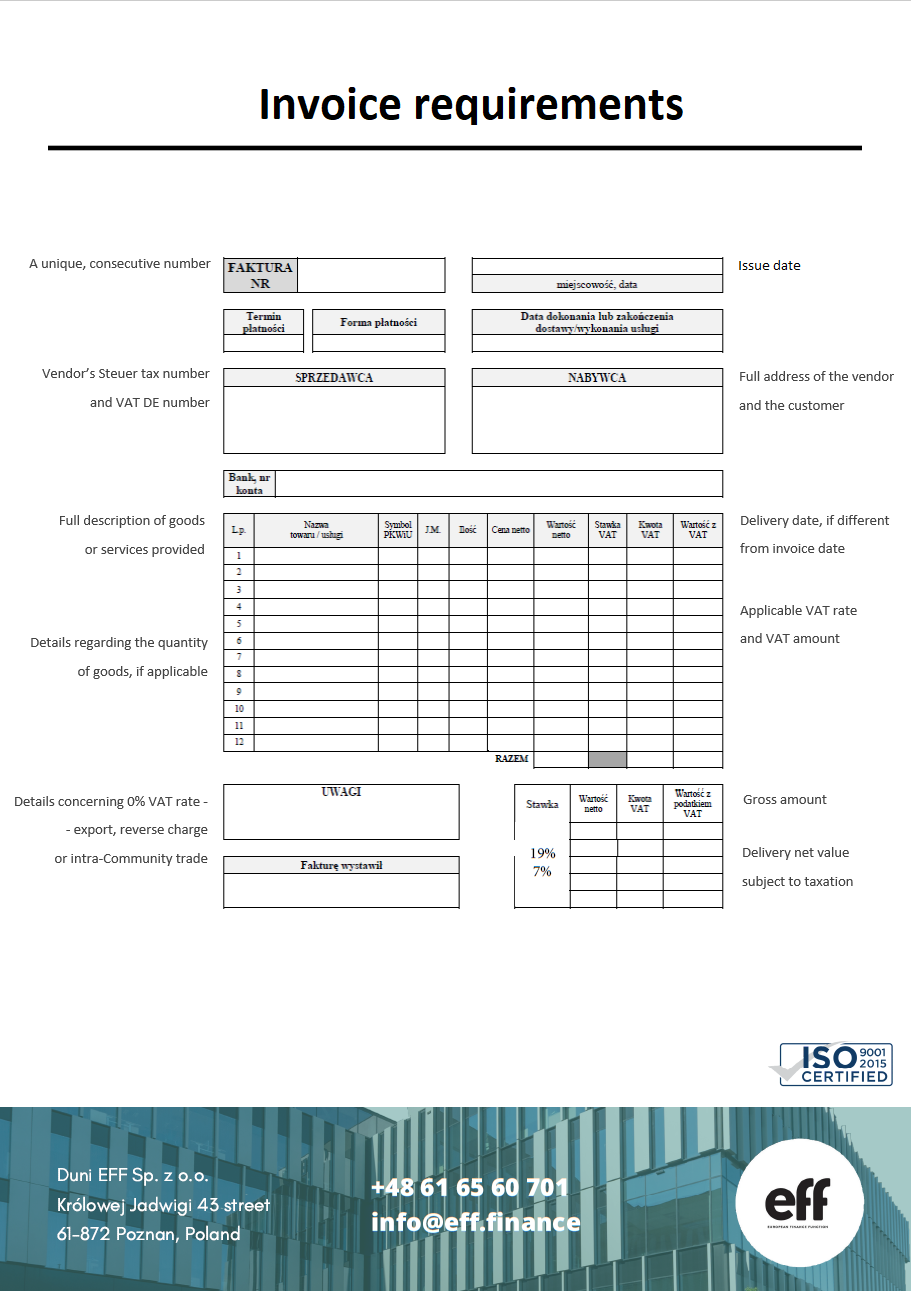
Another important aspect is the fact that a German invoice requires a German tax rate which at the moment is 19% and 7% (reduced to 16% and 5% until the end of 2020 due to the pandemic).
You should also pay attention to the delivery date. If it differs from the sell date it should be indicated on the invoice.
Below you will find a template of a correctly issued invoice with comments. We hope that these guidelines will help you remember what to include on a German invoice.
In case of any questions or queries, we encourage you to contact one of our experts.
The interview began at 11 a.m. on a June morning. It was scheduled for one hour but – to the pleasant surprise of both parties – it took two hours. There wasn’t any script or any pre-prepared questions. The aim of the interview was to get to know the person who has been the manager at Duni EFF – European Finance Center for almost ten years.
Interview with Krister Gullström
The idea originated during Krister’s hospital stay. It turned out that the worldwide isolation caused by the pandemic has affected the day-to-day operations of hospitals, staff, and patients considerably. Krister agreed to talk to me immediately. I encourage you to read the interview below.
Anna Jankowska:In a way, COVID-19 was one of the reasons for this interview… That’s why I wanted to ask you about your view on the post-Covid reality…
Krister Gullström: We need a flexible work model. Up to a certain point the current office size is right just as it is. However, if we want to expand and need to adhere to regulations concerning social distancing, there might be a problem with sufficient office space. I think that the hybrid work model is a good solution. Working from home is a great facilitation for those who don’t live in Poznań.
I’m not sure if I’d like to work solely from home. Staying at home all the time might become boring. Moments of spontaneous conversation when you can come up with different ideas are very important. Remote work model limits the opportunity for interaction. Even team leaders’ meetings held on Teams. Formely, the discussions were much longer. Now, the meetings are much shorter. Online meetings are not conducive to long conversations. For new employees remote work model is not perfect either – it is difficult to get to know your co-workers and the culture of the company from home.
I have a feeling that without any meetings with partners or clients at their headquarters for so long you start losing your grip on what is going on there. Of course, you can always communicate via emails or videoconferences, but it’s not the same.
A: Do you think that professional competencies will change in the future? Will some competencies become more important than others?
K: From the practical perspective, the process of remote work is running smoothly. We have prepared for it. Employees are independent. In the case of working from home, work has to be organized differently. It’s not the same thing as working in the office – if you’re sitting at your desk for 8 hours it means you’re working. For me, the most important thing is what you do. Remote work should not be difficult for an experienced employee. However, proper mentoring and onboarding of new employees is crucial. If you work in the office next to someone with years of experience, you can learn a lot. If you work from home, you don’t have that chance. Day-to-day operations can be easily done from home. However, managerial tasks, coming up with new ideas or mentoring require more mobilization, which makes it more difficult. These are the competencies that need to be developed.
A: Do you think changes are necessary?
K: Of course. Some changes are easy, and some, like company restructuring, are very difficult processes. It’s important to be able to predict and prepare for future changes. When you work for a big corporation and then decide to start your own business, you need a lot of courage, time and work to make it happen. When you want to do something creative – to paint or compose music, then you need to put in a lot of time and be talented.
A: Yet, COVID was not something we were prepared for. Do you think that lockdown was necessary?
K: There might’ve been more possibilities if the society had been better prepared. First, the problem was ignored, and then, hasty and hectic decision were made. If you can’t see something with your own eyes then it doesn’t exist. Until you actually see it, you don’t want to spend money on prevention methods. When no one is ill, you think you don’t need lockdown. But maybe no one got ill because lockdown was introduced. The reality showed that despite isolation people were still getting ill.
A: You had graduated from university long before COVID-19 struck. Have you always planned on following this career path or was it all coincidence?
Krister gave up his own office space to spend more time with EFF employees.
K: I had never planned to work in management control or accounting. When I was at university I wanted to be a Portfolio Manager in Investment Banking or Corporate Finance. My career path was quite coincidental. My first job? I lwas looking for anything. My friend started a company where I worked for 4 years. We provided information services, a type of consulting. We had different data bases at our disposal, e.g. data bases connected to scholarships or other means of funding. We published books. When my friend decided to work in a different field, we went our separate ways. I didn’t want to run that company alone. I got a job in accounting by accident. I was responsible for general ledger consolidation. They quickly needed a temporary replacement. I was supposed to work there for a couple of months, but I stayed for a few years. I learnt a lot, I travelled a lot too, but the job was repetitive. I wanted to gain new competencies and learn about IT systems. I found what I was looking for in a pharmaceutical company. I was the IT systems expert. I worked there for three years. At that time some other company was looking for someone for a Financial Manager position. I thought it would be worth to try, and that’s how I got this job. I never had any long term plans, and yet, I’ve been working at Duni for 10 years.
A: Do you still want to face new challenges at work, or maybe try somewhere else?
K: Working at EFF is very interesting. A lot happens here. There are new challenges to face almost every year. VAT Compliance services are not something I would have thought of three years ago. It would be nice to try something new but I don’t have anything specific in mind yet. I’d like to visit a more exotic place, for example to live in Africa for a few years. My uncle used to be a contract engineer, so he worked in different parts of the world. Maybe I could do some contract projects for an international organization, too.
A: Did you consider living and working in another country?
K: As a child I lived for three years in the USA, so I’d already experienced living abroad. In the final year of my studies I spent a few months in Indonesia as an intern. I wrote a dissertation on sewage systems. When I googled my name, I found it on ISPN (Mentoring Initiative Navigator Program) where my dissertation was submitted. One summer I worked in France. Then I moved to Poland. An opportunity arose, so I took it.
A: Was working and living in Poland a big change for you and your family? Did you compromise or decide on your own to move here?
K:The whole family wanted to move to Poland. My wife especially. We thought it would be only for three years. There aren’t that many differences between living in Poland and in Sweden, as there are between living in the USA and in Sweden. The people and general mentality are quite similar. In the USA people behave differently. They have different values. My daughters were small when we moved, so they can’t compare it. Now, my older daughter is 19 and she lives in Sweden. My younger daughter lives here with me and she’s in high school now. She doesn’t have any fixed plans for the future yet. She keeps coming up with new perspectives and ideas.
A: Fatherhood – what kind of dad are you? Do you instil your own values in your children or do you give them space to discover the world on their own?
K: I am truly lucky to have such decent children. In general, I’m the kind of person who steers clear of conflicts. I try my best to solve problems peacefully. The most important thing is that my children are healthy and happy. What they do and how they live is their choice, they know what is best for them. If the way they live is not detrimental to their health and doesn’t put their lives in danger, then they have my blessing to do as they please.
A: “Because we have limited time” – these words, spoken in a conversation between Bill Gates and Steve Jobs could not describe our current situation more accurately. What about you? Have you rethought your values or started looking at life from a new perspective?
K: I don’t think so. I’ve learnt that life is short long ago. The last 20 years have passed very quickly. I always thought that you have to do as much as you can before it’s too late. You have to use the opportunity you’ve been given and not waste time. If you are dissatisfied with something, and you are ambitious, then change something in your life. Don’t wait for 10 years for it to happen on its own. A few months ago I had a kidney transplant. If you’re lucky, you quickly go back to your normal life after the surgery. If you’re not so lucky – you can end up being disabled. I considered various scenarios. What you can do when you can’t move freely, when you’re ill or disabled. I am very happy that I got so lucky in my life. It’s a waste of time to feel sorry for yourself and be dissatisfied with your life when you’re healthy.
A: Is this your definition of happiness? Do you think we need material things?
K: The most important thing is freedom. It’s enough that you are free to move on your own, that you are not stranded in a hospital or at home. We quickly forget about what is really important. Do material things matter? I think so. But you can’t take them (or yourself) too seriously, so as not to be perceived through the lens of your possessions. Material things do matter, but they are not the most important thing in the world.
A:What do you dislike in other people?
K:I don’t like people who are judgemental and blame others for their own failures, who think that everything is someone else’s fault. When you hold a managerial position, it is one of the worst traits you could have. The second worst trait is not taking responsibility for your own decisions. I hope I do not exhibit such traits.
A:How do you like to spend your free time?
K:Some people have only one passion throughout their entire life. For me there were several in different stages of my life. I played tennis for several years. I don’t play anymore at all. I used to play the guitar, now I rarely do so. There are moments, when I can’t stop reading for a year, and then I have a long break and stop reading altogether. When I was 20 years old, I used to work in a wine shop. My interest in wines is one of the passions that have stayed with me until this day. Nowadays, my favourite way to spend free time is to go on a boat on a sunny day, while drinking coffee and eating some tasty pie.
A:What are the places you’d like to visit, the places you miss?
K: I’d like to visit south Africa, particularly Namibia and Botswana, pristine regions with few inhabitants. Out of all the cities I’ve seen, New York has made the biggest impression on me. The people there are very open. Whenever you go to a restaurant people start conversations with you. I could see myself working there.
A: There is a Mazda MX-5 NC sports car, which you have had for some time now, parked in the underground parking lot. Do you use it only for summer road trips or maybe something else?
K: I’m in the process of modifying that car. I’m preparing to drive on a track. I’ve changed the tires and the suspension. My brother has some engine parts for me. I wanted to participate in Poznań Track Day but COVID made it impossible. Last year I drove on a track in Łódź. I don’t race. The driver drives alone on a track and is being timed. All I need is a racing helmet and a car. I like vintage cars, classics, particularly Ferrari 308 GTB – the one Magnum used to drive in the ‘80s.
A: What should I wish you?
K: For my kidney to work as long as possible and for the wellbeing of my family.
In line with new regulations, as of 1 January 2021, entrepreneurs will be obliged to inform ZUS (the Social Insurance Institution) about concluded specific task contracts. The aim of this change is not only a stricter control over all civil law contracts but also a swifter aid in the Anti-Crisis Shield programme.
Registering specific task contracts
The early days of 2021 brought about many changes for entrepreneurs in Poland, including the new obligation to report specific task contracts to ZUS. The main aim of this solution, as stipulated in the Anti-Crisis Shield programme, is providing effective financial aid to companies affected by the economic crisis due to the COVID-19 pandemic. However, it is not the only advantage of the proposed change. From now on, ZUS will be updated on the number of specific task contracts being concluded in Poland. Until now, ZUS depended only on estimated numbers. Registration of specific task contracts will also enable ZUS to supervise social security obligations.
How to provide ZUS with required information
As of this year, entrepreneurs are obliged to report signed specific task contracts to ZUS no later than 7 days after each contract has been concluded. Contracts can be registered electronically via PUE (Platforma Usług Elektronicznych) on ZUS website. In order to register a contract, a RUD form has to be filled in with all necessary information about the contract in question. New rules apply to everyone – those, who already pay contributions to ZUS, and natural persons, who are not yet registered as contribution payers.
Does every specific task contract have to be registered in ZUS?
There are cases in which specific task contracts do not have to be reported to ZUS. If a contract is concluded between an entrepreneur and their employee, there is no obligation to register it. Other exemptions from the rule include declarations made for the employer but contracted with another entity, and contracts concluded with persons conducting their own business activity, in which case the contract must pertain to the service provided within the nature of that business activity.
In recent years Brexit has raised many questions not only among the British citizens but also among entrepreneurs conducting businesses or planning to expand the scope of their businesses to the British market. For months there have been much speculation about the changes resulting from Britain’s withdrawal from the EU. Today, we can finally rely on verified information regarding changes in trade with the UK and tax consequences resulting from them.
Changes in trade
This article presents two types of goods sold to customers from the UK – goods located in the UK at the point of sale and goods imported to the UK. Other criteria differentiating between the two (such as value of the imported goods, where and how the goods are sold, and legal entities liable for VAT) will be introduced later in the article. All of the changes described below apply from 1 January 2021.
Import of goods from outside the UK in consignments not exceeding £135 in value
To begin with, let us consider goods sent from overseas and sold to UK customers. If such goods do not exceed £135 in value, VAT should be collected when:
goods are sent directly to customers without intermediary warehouses (e.g. Amazon), in other words, selling goods via your own website directly to customers in the UK
goods are purchased via marketplaces such as Amazon and are sent to customers in the UK
The key aspect which determines VAT settlement method is not exceeding £135 in value. Cost calculation methods will be discussed later in this article.
In both cases mentioned above the transaction takes place in the UK, therefore the UK VAT rules must be applied. The two instances differ, however, in determining which party is responsible for VAT settlement.
In the first instance, the party responsible for settling VAT is the seller, in which case, tax rate should be specified at the point of sale. Importing goods to the UK on these terms requires registration as a VAT payer with HMRC.
In the second instance, it is the online marketplace which is responsible for settling VAT.
The situation changes when goods are sold to a business customer. If a customer has a British VAT number, then it is their responsibility to settle VAT. Contrary to non-commercial customers, business customer is issued an invoice (either by the seller or by the online marketplace) which includes information on settling VAT on their own, otherwise known as “reverse charge”.
Transferring obligation to settle VAT onto the customer constitutes one exception when the abovementioned rules do not apply.
Other exceptions include:
import of excise goods, in which case, either the standard import rules apply or one can choose excise tax settlement on their VAT declaration
import of goods from Jersey and Guernsey which are subject to Import VAT Accounting Scheme rules
It’s important to notice that all of the instances described above apply only to goods which do not exceed £135 in value – consignments exceeding £135 are subject to standard VAT and customs rules. The maximum value of £135 pertains to the total value of all goods in a consignment, not to the value of particular items. To calculate the total value of goods in accordance with the new VAT rules, take net value of the goods being sold (not the declared value), excluding possible insurance and custom duty. It is important for choosing a proper VAT calculation method.
VAT compliance
There are several aspects that a VAT payer (a seller or an online marketplace) should consider to correctly calculate VAT for goods imported to the UK which do not exceed £135 in value. These aspects include:
registering as a VAT payer
estimating the nature of goods being sold in order to calculate the right tax rate
verifying information for keeping a proper record of goods sold
What about goods located in the UK at the time of sell?
Selling goods located in the UK to UK customers
The £135 limit does not apply to the sale of goods located in the UK to UK customers, as all such goods of any total amount are subject to VAT, regardless which party settles tax. Goods located in the UK are understood as goods located on the territory of the UK at the point of sale. They can be stored in the seller’s warehouse, in a warehouse rented by the seller or in one of the online marketplace warehouse chains, such as Amazon as part of the FBA service. In accordance with the EU VAT regulations, the seller must also be registered as a VAT payer.
Notice: it is the shipping address to which the goods are sent, and not customer’s citizenship, permanent address or billing address, that determines whether the customer is subject to UK VAT rules.
If the seller delivers their goods directly to the customer (either a business customer or an individual customer) without using services of an online marketplace, then they are subject to the standard VAT rates.
What about sellers who do use online marketplaces?
When goods are sold to customers via online marketplace, that online marketplace is subject to VAT under the British tax rules.
These rules do not apply if the buyer provides the online marketplace with their VAT number. In such a case, the buyer is deemed as a business customer, and it is the seller who is subject to VAT. Therefore, previously discussed reverse charge cannot be applied.
In summation, the new changes in trade with the UK present a number of variables which must be considered when settling VAT. This article provided only a general scope of the matter, serving as an introduction to the subject. Unfortunately, the new regulations will probably lead to restructuring of many enterprises. Changes in document circulation, additional data verification methods, as well as monitoring prices require more work and specialized knowledge. In order to avoid errors in tax settlement or accounting it is best to turn to experienced specialists. We offer expertise in international accounting and VAT compliance. The scope of cooperation depends on client’s individual needs and the pricing is agreed upon individually.
Various media have reported on a new mandatory contribution to be paid to ZUS for all civil law contracts to be in force from 2021. Until now, employees performing work under contract of mandate were able to avoid paying health insurance contributions in certain situations. Although this information was not yet officially confirmed by the government, new questions arise regarding the consequences of the proposed changes for the employees and the employers.
Obligatory contributions to ZUS for contracts of mandate
As contracts of mandate fall under the civil law contracts category, additional contributions to ZUS do not apply (only in case of the first contract and a remuneration lower than minimum wage). Employees could then pay contributions to ZUS on their own or decide not to do it at all and not to save up for their retirement. Such a solution is perfect for those who prefer receiving the whole sum of their remuneration now, but it will not satisfy those, who would rather receive a higher pension in the future.
Changes in ZUS contributions planned for 2021
Proposed changes regarding obligatory contributions to ZUS aim at increasing pension benefits for employees who work on a mandate contract basis. According to experts, sealing pension scheme is crucial in providing better pension benefits than the existing ones.
According to new rules, civil law contracts would be subject to ZUS contributions, if:
an employee works on two or more contracts of mandate basis
a person was employed by the employer both on a contract of employment and a contract of mandate basis
a person performs tasks on a mandate contract basis for one employer and works on an employment contract basis for another employer
a person conducts their own business activity while working on a mandate contract basis
Imposing a comprehensive obligatory contribution to ZUS means changes for both employees and their employers. For employees it will mean lower remuneration, and for employers higher costs of employment. Contributions received by ZUS will be allocated to the future pension scheme.
What will the proposed changes bring?
With new regulations comes a variety of advantages. Firstly, they would allow to minimize such malpractices as postponing of signing employment contracts indefinitely by employers. But most importantly, they would provide employees with both health and pension benefits.
There is also a risk of employers deciding not to suffer the costs of hiring employees on a mandate contract basis. Employees themselves may not be satisfied with a lower remuneration. It may even lead to both groups choosing task specific contracts (not subject to ZUS contributions yet) instead or contributing to informal economy.
Where to find information on the proposed changes for 2021?
Information on obligatory contributions to ZUS for contracts of mandate can be found on official government websites, mainly Ministry of Family and Social Policy website. It is also important to follow the news and remember that new regulations can be introduced in the early 2021. The impact these new changes may have on both employers and employees is being analysed by experts.
Polish tax law will face many changes in 2021, including changes in JPK (the Polish Standard Audit File for Tax). The new regulations regarding VAT declaration JPK_V7 have already been applicable from 1 October 2020. VAT payers must submit both VAT declaration and transactional VAT records in one electronic form. Yet this is not the only change in JPK, there are other new rules which must be observed as an incorrectly filed declaration may lead to a fine.
New JPK format – what to look out for?
Changes in JPK should not come as a surprise, as they were already announced in 2019. Submitting one form with monthly (JPK_V7M) or quarterly (JPK_V7K) declarations in an electronic format is much more convenient for many reasons. However, quarterly declarations still require settling transactional VAT records on a monthly basis. There are also more details to revise.
JPK facilitates the process of settling VAT and speed up the process of data verification of a given document. JPK format includes not only VAT declarations (purchase and sales records) but also JPK_WB (bank statements), JPK_PKPIR (revenue and expense tax ledger), JPK_EWP (revenue registry) and JPK_KR (accounting ledgers). It enables a detailed verification of information on a given enterprise.
GTU codes – a significant change for some entrepreneurs
Changes in JPK also include providing mandatory GTU codes for sensitive goods and services. There are 13 GTU groups assigned to goods or services subject to increased tax control. These items include goods such as alcoholic beverages, tobacco products, secondary raw materials, electronic devices, vehicles and car parts, fuels and diesel oils, precious and non-precious metals, medications and medical devices, and building materials.
Services which require GTU codes include transport services and warehouse management, services regarding greenhouse gas emission, and the so-called intangible services. Intangible services include such fields as accounting, legal, marketing, advertising, consulting, training and research.
How to structure JPK?
JPK format must be kept in accordance with Ministry of Finance’s recommendations. Tools necessary for generating and correctly filling the JPK form are made available by Ministry of Finance, along with a brochure outlining any new regulations, which one should become familiarized with before submitting the form. All tools on government websites are kept up to date and are compliant with new regulations. There are, of course, other methods of generating JPK forms, such as using a paid JPK form version provided by GOFIN. The paid version of GOFIN format includes access to VAT declarations and transactional VAT records submitted in the JPK, as well as support in the electronic filing process.
The Minister of Development Funds and Regional Policy announced that as of next year limited partnerships, similarly to companies and limited joint-stock partnerships, will be subject to corporate income tax. Due to the difficult economic situation entrepreneurs have been given time until the end of April to acquaint themselves with the proposed changes. The new law will be applicable from May, although most of its solutions could take effect as of 1 January 2021. It means that entrepreneurs running limited partnerships will face some big changes in how they conduct their business.
Why limited partnerships will have been taxed under corporate income tax?
According to the Ministry of Finance, such a solution is crucial, as current regulations regarding limited partnerships exhibit inaccuracies. Audits conducted by the Ministry have indicated that those who decide on forming a limited partnership subsequently avoid paying taxes. This, in turn, leads to reducing the competitiveness of companies and lower revenue of the Treasury. However, a stricter control of limited partnerships is not the only benefit of the new law legislators foresee. The new regulation will also include a maximum abolition tax relief deduction amount, as well as the increase of a revenue limit for current fiscal year enabling entrepreneurs to benefit from a reduced corporate income tax rate.
The opponents of the proposed solution point out that avoiding taxation is a rare reason for choosing a limited partnership. They also call for attention to the high risk of bankruptcy and going out of business for those who will have to adjust to the new regulations and pay corporate income tax. At the same time, they argue that the time to familiarize oneself with the new regulations is too short to properly prepare oneself for the changes to come, even if the law should take effect in May 2021. Moreover, the timing of the announcement of the amendment didn’t go unnoticed, as many businesses are and for the next several months will be struggling financially due to the current economic situation caused by the pandemic.
The changes to come
The new regulation involves changes in legislation regarding:
Personal Income Tax Act
Corporate Income Tax Act
Act on the Lump-sum Income Tax on Certain Revenue Earned by Individuals
In accordance with the announcement, entrepreneurs running limited partnerships are going to have to pay income tax in the amount of 19% beginning with May 2021. The proposed changes also include raising the revenue limit for the current fiscal year which allows a lower CIT in the amount of 9% to 2 million EUR. Similarly, the flat rate limit would also be raised to 2 million EUR.
Another change encouraging running business in Poland is the introduction of 1,360 PLN limit on the tax abolition relief. According to the analysis of the Ministry of Finance, current tax abolition relief is not satisfactory enough for the entrepreneurs to conduct profitable business activity in Poland.
For entrepreneurs whose revenue for the previous fiscal year did not exceed 50 million EUR, and for tax capital groups despite their revenue, the proposed changes would mean the obligation to declare their tax accounting method. All of these changes remain a subject of debate with entrepreneurs.
The COVID-19 pandemic Poland has been struggling with since March 2020, results in many considerable consequences for international economy.
The impact of the pandemic
Many businesses were forced not only to slow down their activity, but even to abandon their original business plans. As a result, it put a strain on overall financial liquidity and effective budgeting. Many projects were postponed indefinitely, some were carried out only partially, and the majority of them were suspended or completely terminated.
The unfavorable situation of Polish entrepreneurs is further exacerbated by the unpredictability of the pandemic and its consequences in the future. In such uncertain times, maintaining financial liquidity is crucial. But how to do it? Even during an economic crisis like this one, it is possible to budget and plan possible investments effectively. All one needs, is to know their options.
How to manage your finances during a pandemic?
An economic slowdown may result in negative consequences in the future which entrepreneurs should already think of, as the resolution will not come with the vaccines or the decrease in numbers of the infected. The repercussions of the COVID-19 outbreak will be noticeable long after the WHO announces the end of the pandemic. A question arises, then – how to protect oneself from losing control over one’s business? It is obviously impossible to go back to the situation from February last year. It will also be challenging to regain financial liquidity at a satisfactory level. However, market analysts recommend some solutions to this problem.
How to obtain additional funding?
The first decision that entrepreneurs should make is to try to gain funding for their investments. Applying for either the Anti-Crisis Shield programme or reaching a credit limit may bring noticeable yet short term benefits for businesses. Replenishing the budget or paying outstanding remuneration are not the only challenges faced by entrepreneurs due to the pandemic. In order to maintain financial liquidity and plan new investments new and more advanced approach must be taken.
Businesses wishing to stay in the market should adopt new methods of crediting. These would require renegotiating terms of their loans with banks which also struggle with the current crisis. In order to obtain new funds on favourable terms, it is necessary to put forward one’s needs clearly, and be able to compromise. Another good idea would be choosing a lease over a purchase. Leasing all business necessities has been a preferred method for smaller businesses, and it is likely to be a far better solution even in the future.
The highest value of saving up
There are plenty of methods of saving up. Business owners who are not afraid of cutting costs, and those looking for new ways to save up, should revise their business plans in the context of such unpredictable variables as a pandemic. The key aspects to reconsider will be planning, more scrupulous monitoring of expenses on a weekly rather than monthly basis, as well as setting priorities. It will enable entrepreneurs to have a better control over the cashflow and predict their future expenses easier. New sources of additional funds can also be found through cost reduction wherever it is possible (e.g. vendors or marketing), or through suspension of any investments for a couple of months.
Although it had been announced long before it took place, UK’s withdrawal from the EU caught many businesses cooperating with British enterprises off guard. Enterprises trading with the UK via Amazon were also made feel ill at ease.
Will Brexit affect e-commerce?
It comes with no surprise that the e-commerce industry is concerned about Brexit and its consequences. There are many doubts about how to maintain trade using Amazon services after UK is no longer a part of the EU. This issue involves not only sellers of goods in the UK but also those who send goods to the UK from overseas.
Changes to be made by the end of 2020
The UK has not left the EU abruptly – were that to happen, the world economy would have crumbled. That is why, the existing arrangement includes a transition period which will last until the end of 2020. By that time, Britain should secure their deals not only with the European countries but also with the rest of the partner countries. Until then, all transactions via Amazon will be conducted as usually. UK has time until the end of year to reach an agreement with the EU and ensure that international trade remains uncompromised.
Amazon and Brexit – what to prepare for?
Traders should prepare themselves for huge changes after January 1st, 2021. If UK does not reach an agreement with the EU by that time, complications may arise. Were that to happen, it would become challenging to decide how to settle VAT and whether to impose custom duty on goods imported to the UK. Sellers using Amazon should also take into consideration that Brexit may discontinue FBA inventory transfers between the UK and the EU. What it means is that UK stock warehouses will no longer be used to fulfil orders in Europe. However, such inventory transfers will still operate in Germany, Spain, Italy and France. From 2021, UK and the EU will become separate entities. Moreover, sellers should acquaint themselves with the new rules regarding customs duty – they might require hiring new staff to manage it.
Traders who sell their goods directly via FBM should also be vigilant in terms of new rules.