
In October 2025, the European Parliament rejected the proposed simplifications to the CSRD and CSDDD directives, which means their final form is still taking shape. The next vote is scheduled for November. If the proposed compromise is adopted, the new thresholds for mandatory ESG reporting would come into effect no earlier than 2026, and CSDDD-related obligations would begin applying from 2029. For companies with fewer than 1,000 employees, this is a period of uncertainty—but also an opportunity to make strategic decisions.
Does ESG reporting still apply to you?
According to current proposals:
- CSRD would apply to companies with more than 1,000 employees and over EUR 450 million in net turnover.
- CSDDD would apply to companies with more than 5,000 employees and turnover above EUR 1.5 billion.
For companies below these thresholds, this would mean one thing: the formal obligation to report may no longer apply. But this does not mean ESG stops being relevant—quite the opposite.
ESG reporting not only helps you meet market expectations but, above all, allows you to identify risks that may translate into real financial losses—from supply chain disruptions and increasing energy costs to the potential loss of contracts.
Why voluntary ESG reporting is worth the effort
1. Maintaining your position in the supply chain
According to the report Decarbonisation Is Already Here, prepared by the Climate & Strategy Foundation, 72% of SMEs using their calculator state that clients ask them about their carbon footprint—19% receive such questions regularly.
If your company supplies goods or services to larger entities, it is worth being prepared for these inquiries. A lack of data may lead to losing a contract to a competitor who has those figures ready.
2. Risk assessment by financial institutions
Banks and investment funds still need to report ESG under their own regulations, and nothing indicates this will change soon. They rely heavily on data provided by their clients to meet these obligations. This means the absence of ESG policies may negatively affect the risk assessment of companies applying for financing.
Example: A construction company with no adaptation plan for extreme weather events may be considered high-risk and receive worse loan terms—or be denied financing altogether.
Book a non-binding consultation and learn how to meet regulatory expectations safely and efficiently.
3. Insurance and climate-related risks
Climate change affects not only energy costs and resource availability but also insurance pricing. Insurers increasingly require ESG data to assess operational risk. For example, a logistics company without a climate risk analysis may be unable to secure coverage for a warehouse in a flood-prone region. In 2022, Poland’s largest energy companies spent PLN 31 billion on emissions allowances alone—nine times more than four years earlier.
4. Early identification of financial risks
A properly conducted analysis of carbon footprint, resource consumption, and ecosystem impact helps identify risks before they become costly. For instance, identifying the risk of rising electricity prices and investing in your own renewable energy source can protect your operating costs in years to come.
5. ESG as a competitive advantage
Companies that report ESG manage costs more effectively, attract investors, and build business resilience. In municipal tenders, requirements such as fleet electrification increasingly influence contractor selection.
Research results presented in the Ayming International ESG Barometer 2025 clearly show that businesses are developing a deeper understanding of ESG. When asked about progress in implementing selected ESG solutions, 35% of companies indicated they have already implemented e-mobility (e.g., EV infrastructure), and another 48% plan to do so. This means that staying competitive requires keeping pace with the sustainability initiatives your competitors are already implementing.
What can you do right now?
If your company falls below the new thresholds, you can decide how to proceed—but taking a thoughtful, strategic approach will help you make the most of this flexibility:
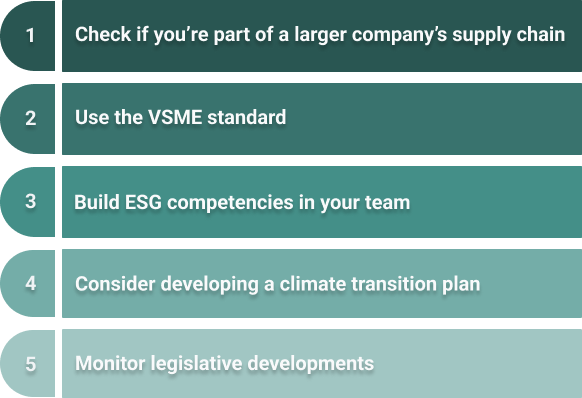
1. Check whether you’re part of a larger company’s supply chain
If your clients fall under CSRD, expect inquiries about their emissions, environmental policies, and broader ESG risks. Even without formal reporting, it is beneficial to implement basic due diligence procedures.
2. Use the VSME standard
The European Commission plans to launch a free portal providing guidance and reporting templates for small and medium-sized businesses. It offers a straightforward, accessible starting point that aligns with current market expectations.
3. Build ESG competencies in your team
Even a basic report relies on accurate data, clear processes, and team engagement. Starting early makes it easier to build toward more advanced practices over time. Begin with straightforward assessments—such as energy consumption, Scope 1 and 2 GHG emissions, or diversity policies.
4. Consider developing a climate transition plan
While it is not mandatory, preparing one can be highly beneficial. Companies that develop such plans are better equipped to navigate rising energy prices, evolving regulations, and increasing client expectations. In 2023, 54% of companies published a transition plan, and 40% set a net-zero target..
5. Monitor legislative developments
The Omnibus proposal has not been adopted, and another vote is scheduled for November. Keeping track of these developments will help you stay prepared.
Summary: Don’t wait—act!
Changes in CSRD and CSDDD are not merely deregulation—they signal that the EU is seeking balance between climate ambitions and business realities. For companies under 1,000 employees, this is the moment to make a conscious decision.
ESG is here to stay. As its form, scope, and pace evolve, companies that embrace it now will not only secure regulatory clarity but also position themselves for meaningful, lasting market advantage.
If you want to discuss how to approach ESG in your company—we’re here to help. We support companies under 1,000 employees in implementing ESG practices, building resilience, and preparing for the future.